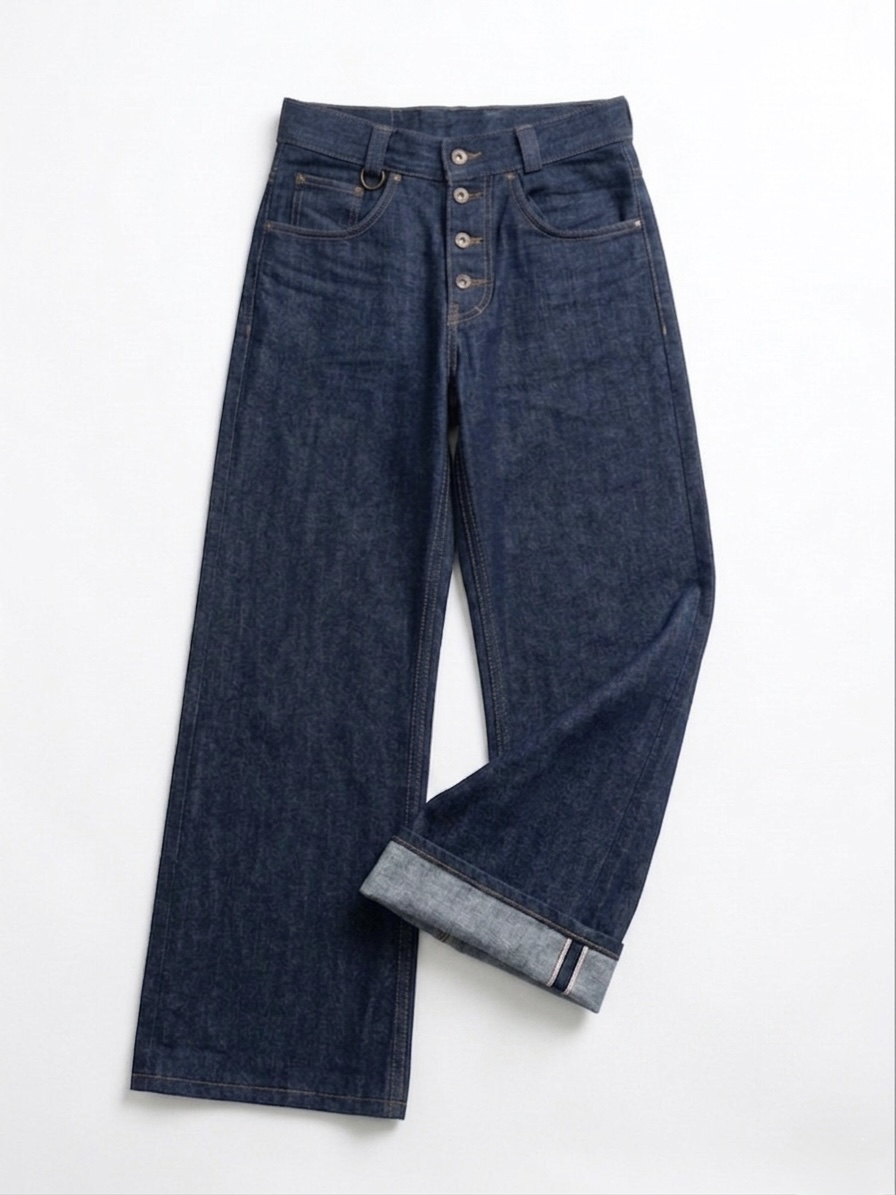
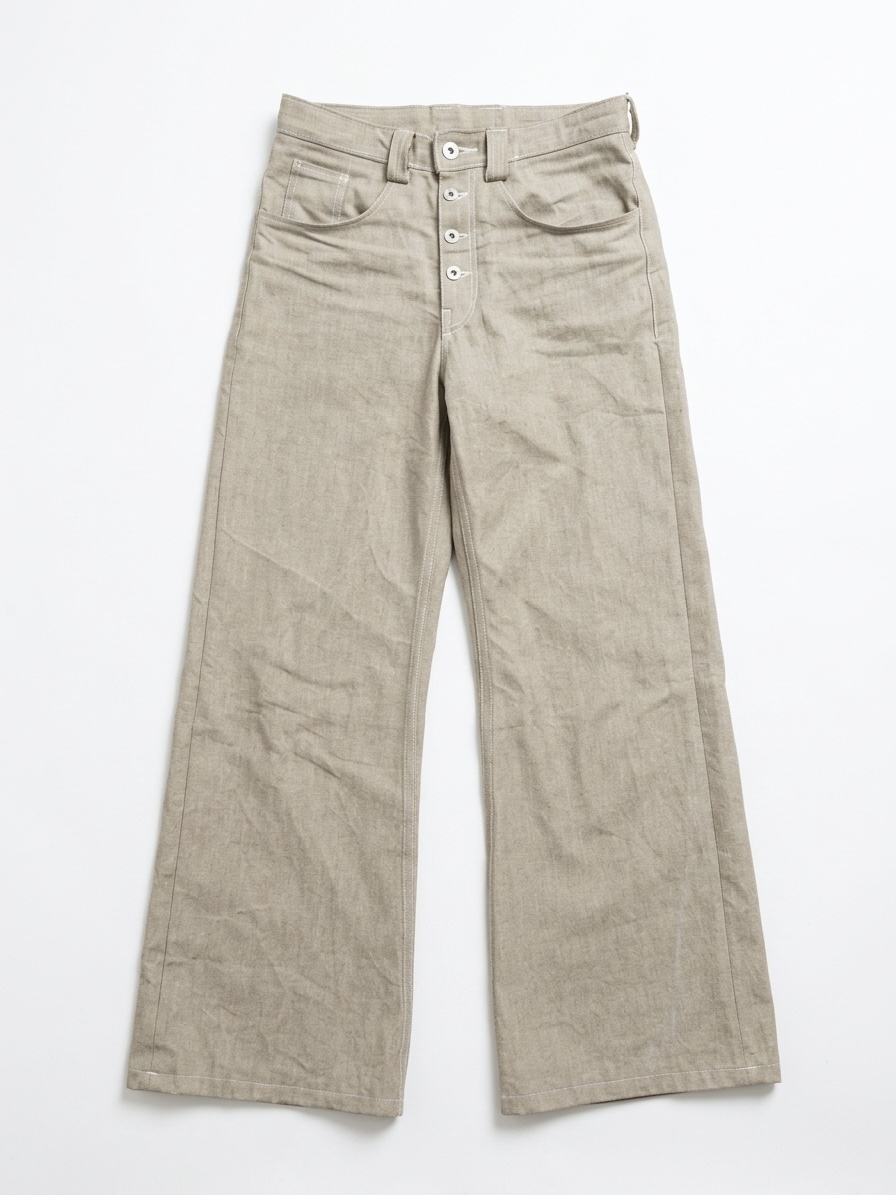
Every pair starts as a digital pattern in CLO3D. I can see how it fits, how it drapes, how it moves — before a single thread of selvedge denim is touched.
The traditional way to make trousers is to start from a basic block — a flat pattern adapted from a standard size — and then fit and adjust on a real person, cutting fabric, pinning, re-cutting. It works. But every mistake costs fabric, and fabric is the most expensive part of the whole process.
CLO3D is 3D garment simulation software. It was built for the fashion industry — brands like Levi's and Acne use it for development. I use it at the start of every commission to build, fit and refine the pattern digitally before anything is cut.
The result is that by the time I pick up scissors, I already know the pair fits. Not approximately — precisely.
Virtual fit preview — CLO3D simulation, raw Japanese 14oz selvedge
Step by step
When you order, you tell me your measurements and which sizing option you want — standard or made to measure. For MTM, I build the pattern from your body. Natural waist, high hip, inseam: three numbers that determine everything. No averaging, no grading up or down from a closest size.
I draft the pattern directly in CLO3D — waistband, yoke, front and back panels, fly facing, pockets. Every seam is drawn as a vector shape. The software stitches the 2D panels together in real time and simulates how the fabric would hang on a virtual body, accounting for the weight and stretch of the actual denim I'm using. 14oz selvedge behaves differently to regular cotton — CLO3D knows that.
I can see the seat, the thigh, the break at the ankle — all before I've touched the fabric. If the high hip is pulling or the inseam is landing wrong, I correct it in the pattern. This is the part that would normally require a muslin toile, a fitting, and another round of cuts. I do it in software instead. No wasted denim. No guessing.
Once the pattern is locked, I export the pieces and print them full-scale. Then I lay them on the fabric — selvedge edge aligned, grain line straight — and cut by hand. No laser cutter, no die press. A rotary blade, a ruler and a cutting mat. Slow, deliberate, one piece at a time.
Every seam is sewn on a single-needle industrial machine. Flat-felled inseam, chain-stitched outseam, bar-tacked stress points. The button fly is set by hand. The selvedge ID runs along the outseam at the hem — you can see it when you roll the cuff. That's the mark. Three to five weeks from order to your door.
Software
CLO3D
Fabric
Japanese 14oz selvedge
Construction
Hand cut, hand sewn
Output
Four pairs a month